

Introduction
8th grade STEM preparation begins long before the first day of school. Here's the real question: Why do students with excellent grades often struggle to stand out when applying for competitive STEM opportunities a few years later?
The answer is surprisingly simple. Strong grades demonstrate academic consistency, but they rarely demonstrate problem-solving, creativity, engineering thinking, or the ability to apply knowledge to real-world challenges. The summer before eighth grade offers an ideal opportunity to begin building these capabilities through structured, project-based STEM experiences.
Students who spend this time creating, experimenting, and solving authentic problems develop habits that continue paying dividends throughout high school and beyond.
Table of Contents
- Why the Summer Before 8th Grade Is the Perfect Time to Build STEM Skills
- Essential STEM Skills Every Rising 8th Grader Should Develop
- A Summer Learning Plan for Future STEM Students
- How One Student Built a Community App for Figure Skaters
- How Real-World STEM Projects Build Confidence Before High School
- FAQs
- Conclusion
Why the Summer Before 8th Grade Is the Perfect Time to Build STEM Skills
The summer before eighth grade provides uninterrupted time for exploration, allowing students to build foundational STEM abilities without the pressure of grades, homework, or standardized tests. Research consistently shows that meaningful summer learning improves academic readiness while reducing learning loss.
Middle school represents an important transition. Students move from learning scientific concepts to applying them in increasingly complex situations. According to the National Science Foundation, authentic STEM experiences improve scientific reasoning, computational thinking, and long-term interest in technical careers. Similarly, reports from the OECD emphasize that project-based learning strengthens problem solving, collaboration, and persistence, which remain among the most valuable future workforce skills.
Instead of memorizing facts, students benefit most when they investigate questions such as:
- How can AI identify recyclable materials?
- Why do recommendation systems work?
- How can data improve community decisions?
- Can simple machine learning models solve everyday problems?
These questions encourage engineering thinking rather than passive learning.
Students who begin developing these habits before high school often transition more confidently into advanced coursework because they have already learned how to think like builders instead of simply completing assignments.
The next step is understanding exactly which STEM skills deserve attention this summer.
Recommended Sources
Essential STEM Skills Every Rising 8th Grader Should Develop
The most valuable 8th grade STEM skills extend beyond mathematics and science content. Students should develop computational thinking, scientific investigation, communication, and project design because these abilities transfer across every STEM discipline.
Rather than studying isolated topics, successful learners combine several complementary skills.
Core competencies include:
- Python programming fundamentals
- Data collection and visualization
- Basic machine learning concepts
- Scientific research methods
- Technical writing
- Presentation and communication
- Collaborative problem solving
- Ethical AI awareness
Organizations including Code.org and the U.S. Department of Education continue emphasizing computational thinking as a foundational literacy alongside mathematics and reading.
Equally important is learning how to define problems clearly before attempting solutions. Students who practice identifying user needs, gathering evidence, and evaluating results build engineering habits that remain valuable throughout high school.
Readers interested in structured AI learning pathways may also find our guide on Top AI Summer Programs for Grades 8–12 in the US helpful:
Once students understand the skills they need, creating a realistic summer schedule becomes much easier.
A Summer Learning Plan for Future STEM Students
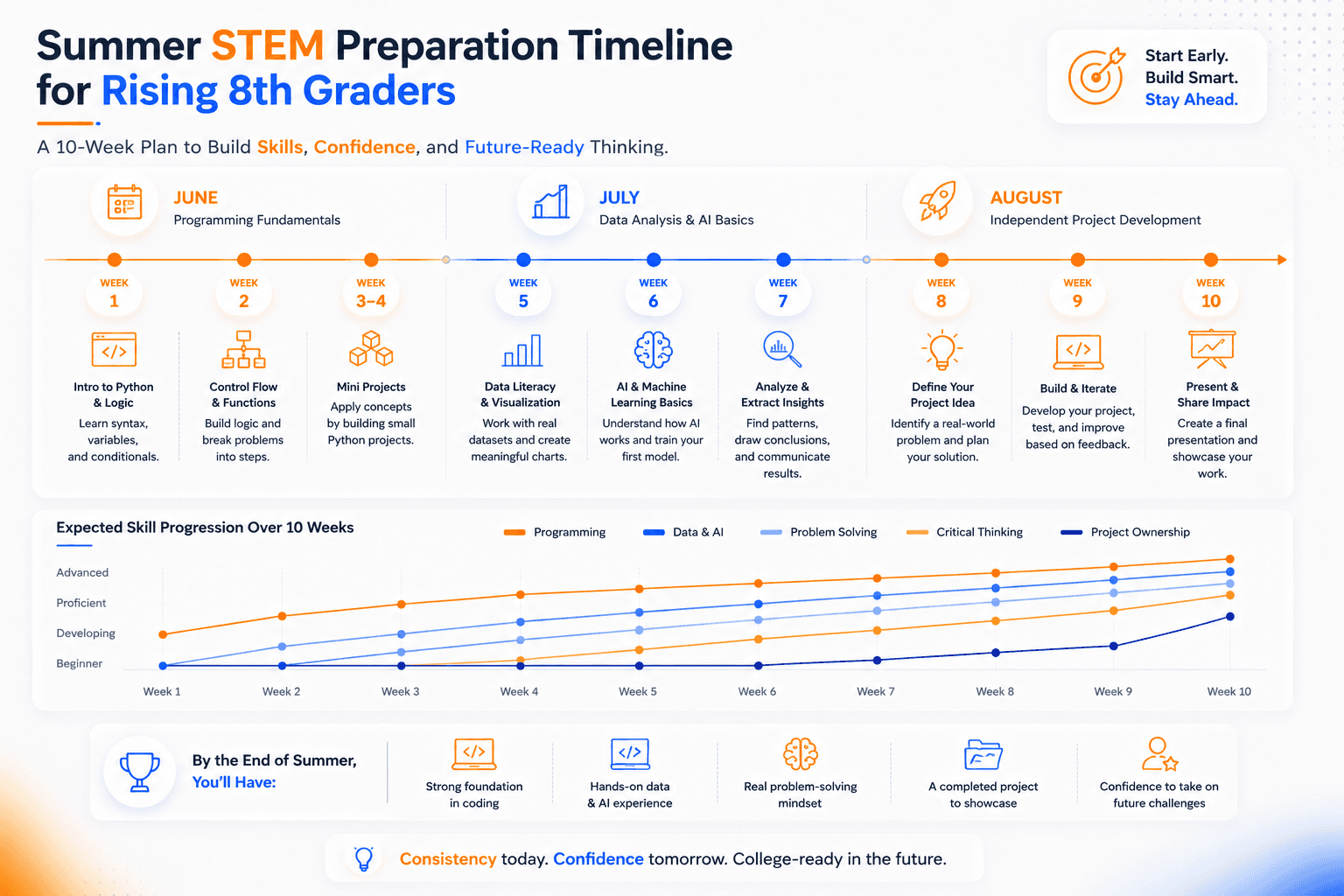
A structured summer plan should gradually increase complexity through guided learning, small experiments, and one substantial project. Consistency matters far more than studying for long hours on occasional days.
One effective eight-week framework includes:
Weeks 1 to 2
- Python fundamentals
- Logical thinking exercises
- Small coding challenges
Weeks 3 to 4
- Data collection
- Visualization
- Introduction to AI concepts
Weeks 5 to 6
- Machine learning basics
- Real-world datasets
- Guided project development
Weeks 7 to 8
- Independent project
- Documentation
- Presentation
- Reflection
This progression mirrors educational research supporting scaffolded learning, where students receive decreasing levels of support as confidence grows.
Mentorship also plays a significant role. Feedback helps students refine ideas, avoid frustration, and learn professional workflows that are difficult to discover independently.
Students considering longer learning pathways may also benefit from reading:
- The Best Self-Paced AI Programs for High School Students in 2027
bettermindlabs.org
The value of this structured approach becomes clearer when examining a real student project.
How One Student Built a Community App for Figure Skaters
Real-world STEM projects teach lessons that textbooks cannot. One student, Grace Young, recognized an overlooked problem within the figure skating community.
Figure skating can be surprisingly isolating. Athletes often train individually, compete independently, and rarely connect with peers practicing similar routines.
Rather than accepting this limitation, Grace designed a community application that allows figure skaters to:
- Find nearby practice partners
- Chat with fellow skaters
- Schedule training sessions
- Build supportive local communities
Although the technical implementation required programming, user research, interface design, and iterative testing, the project's greatest strength was identifying a genuine human problem before writing any code.
This reflects a common principle across engineering disciplines: successful products solve meaningful problems rather than showcasing technical complexity.
Students who complete projects with authentic users also develop stronger communication, research, and presentation skills because every design decision must be justified.
Readers interested in research-focused learning can also explore:
Top Research Programs for High School Students in 2027
The next question naturally follows: why do these experiences create lasting confidence?
How Real-World STEM Projects Build Confidence Before High School
Project-based STEM learning develops confidence because students repeatedly experience the complete engineering cycle: identifying problems, designing solutions, testing ideas, receiving feedback, and improving results. This process builds resilience that traditional classroom assignments rarely replicate.
Confidence grows through evidence rather than encouragement.
Students completing authentic AI or engineering projects learn to:
- Break large problems into manageable tasks.
- Explain technical concepts clearly.
- Interpret data objectively.
- Accept constructive feedback.
- Improve through iteration.
Educational researchers at Edutopia and Project Based Learning Works (PBLWorks) continue documenting improved engagement, deeper conceptual understanding, and stronger long-term retention among students participating in authentic project-based learning environments.
This is also why structured mentorship matters. Experienced mentors guide students through uncertainty while allowing them to make meaningful decisions independently.
By the beginning of high school, students who have already completed substantial STEM projects possess both technical foundations and the confidence to pursue more advanced opportunities.