

Introduction
Summer slide before 8th grade is often treated as a reading problem. But what if the real risk is much bigger?
Many ambitious students spend summer completing worksheets, attending short camps, or reviewing last year's material. By the time school begins, they may remember more vocabulary, but they have not developed the curiosity, problem-solving ability, or portfolio that increasingly distinguishes exceptional students. The students who stand out are not simply studying more. They are building, experimenting, and solving real problems. That difference begins long before high school.
Table of Contents
- What Is the Summer Slide and Why Does It Matter Before 8th Grade?
- Why the Summer Before 8th Grade Is More Important Than Most Parents Realize
- 7 Practical Ways to Prevent the Summer Slide Before School Starts
- How One Student Built an AI Mental Health Companion to Support People in Crisis
- How Project-Based Learning Keeps Students Engaged Throughout the Summer
- FAQs
- Conclusion
What Is the Summer Slide and Why Does It Matter Before 8th Grade?
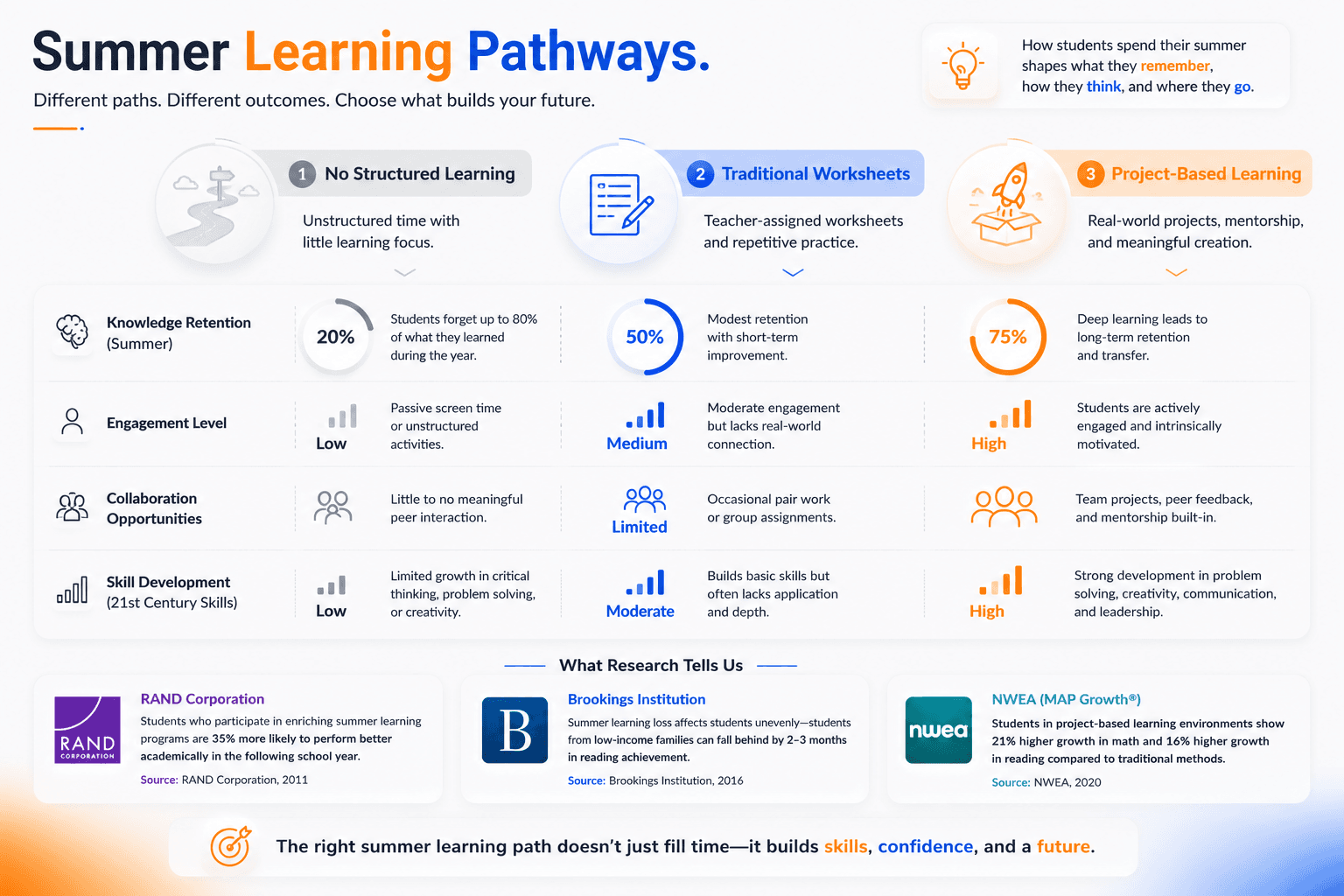
The summer slide refers to measurable learning loss during extended school breaks. Before 8th grade, this matters because foundational reading, mathematics, and analytical thinking directly influence future success in advanced coursework, STEM education, and selective academic opportunities.
Research consistently shows that students can lose weeks of academic progress over summer vacation when learning stops entirely. Recent analyses from organizations including the RAND Corporation, NWEA, and the Brookings Institution suggest that learning growth is highly uneven during summer. Students who engage in structured educational activities maintain or improve their academic performance, while others experience noticeable declines.
The summer before 8th grade deserves special attention because it sits at an important transition point. Students are preparing for more rigorous mathematics, laboratory sciences, structured writing, and increasingly independent learning.
Instead of asking, "How do we prevent learning loss?" parents may benefit from asking a better question:
How can summer become a period of meaningful academic growth instead of maintenance?
That shift leads naturally to understanding why this particular summer matters more than many families realize.
Why the Summer Before 8th Grade Is More Important Than Most Parents Realize

The summer before 8th grade is a strategic opportunity because students possess enough academic maturity to complete authentic projects while still having flexibility to explore interests before high school demands increase.
Middle school marks a shift from memorizing information toward applying knowledge across subjects.
Students begin asking questions such as:
- How does artificial intelligence recognize images?
- Why do recommendation systems predict preferences?
- How can programming solve everyday problems?
Those questions cannot be answered through worksheets alone.
Educational psychology consistently shows that deep learning occurs when students actively create rather than passively consume information. Building a project combines research, mathematics, communication, creativity, and persistence into one integrated learning experience.
Parents looking for meaningful summer activities may also find value in this guide on What should an 8th grader do over the summer, which explores balanced academic planning beyond traditional enrichment.
Understanding the importance of this transition raises another question: what should students actually do during the summer?
7 Practical Ways to Prevent the Summer Slide Before School Starts
Preventing the summer slide requires consistent intellectual engagement rather than constant academic pressure. Small daily habits combined with meaningful projects create stronger long-term learning outcomes than repetitive review exercises.
Here are seven evidence-based strategies.
1. Read beyond school assignments
Choose nonfiction, biographies, scientific discoveries, or technology books that encourage questioning rather than memorization.
2. Practice mathematics through real situations
Budget planning, coding challenges, probability games, and statistics make mathematical thinking practical.
3. Learn basic programming
Python introduces logical reasoning while remaining accessible to middle school students.
4. Build one meaningful project
Instead of completing ten disconnected activities, spend several weeks solving one authentic problem.
Students looking for inspiration can explore 5 AI Projects an 8th Grader Can Start Building Today.
5. Develop communication skills
Explain your project through presentations, short videos, or written reflections. Teaching reinforces understanding.
6. Receive regular feedback
Mentorship accelerates learning because experienced instructors identify mistakes early and introduce stronger approaches.
7. Balance learning with exploration
Outdoor activities, hobbies, reading, and family experiences support creativity and prevent burnout.
Notice that every recommendation shares one characteristic: students actively create something rather than simply consume information.
The next story illustrates what that can look like.
How One Student Built an AI Mental Health Companion to Support People in Crisis
Authentic projects transform academic knowledge into practical problem-solving. One middle school student demonstrated this by creating an AI application addressing a real healthcare challenge rather than completing a hypothetical classroom assignment.
Most mental health crises happen when professional support is unavailable.
Recognizing this challenge, BetterMind Labs student Adwita Kundu built Calm Compass, an AI-powered mental health companion designed to support users during stressful moments before professional care becomes available.
The application can:
- Listen to immediate emotional concerns
- Generate personalized coping recommendations
- Help regulate panic before emotions escalate
- Provide continuous support without judgment
- Encourage users to seek professional care when appropriate
The project addressed an important public health challenge.
Recent mental health research highlights several realities:
- Approximately 1 in 5 adults experience mental illness each year
- Many mental health crises occur outside normal clinical hours
- Therapy wait times commonly extend three to six months
Rather than replacing therapists, Calm Compass helps bridge the gap between recognizing distress and accessing professional treatment.
Projects like this require students to combine programming, artificial intelligence, user research, ethical reasoning, communication, and design thinking. Those interdisciplinary experiences are difficult to replicate through traditional summer assignments.
The success of projects like Calm Compass raises an important educational question: why are projects so effective compared with conventional summer learning?
How Project-Based Learning Keeps Students Engaged Throughout the Summer

Project-based learning sustains motivation because students apply academic concepts toward meaningful goals while receiving continuous feedback from mentors instead of working through isolated assignments independently.
A structured learning model typically includes four components:
- Foundational instruction in programming and AI concepts.
- Weekly mentorship with experienced instructors.
- Progressive project milestones with continuous feedback.
- Public presentation of completed work.
This mirrors how engineers, researchers, and entrepreneurs develop solutions in professional environments.
Students participating in structured AI programs often finish summer with something tangible: an application, machine learning model, research presentation, or portfolio project demonstrating genuine technical ability.
Families comparing educational opportunities may also find this overview of Top AI Summer Programs for Grades 8-12 in the US useful when evaluating different learning approaches.
The strongest programs emphasize mentorship, collaboration, and authentic problem-solving rather than passive instruction.
FAQs
Conclusion
The summer slide before 8th grade is not simply about forgetting multiplication tables or vocabulary. It is about whether students spend an entire season maintaining knowledge or creating something meaningful.
Grades, test scores, and classroom performance remain important, but they no longer tell the complete story. Students increasingly distinguish themselves through initiative, creativity, collaboration, and their ability to solve real problems.
That is the philosophy behind BetterMind Labs. Rather than asking students to memorize AI concepts, the program guides them through building real applications under expert mentorship, developing technical confidence while creating projects that demonstrate genuine capability.
If your goal is to transform this summer into a period of measurable growth instead of academic maintenance, explore the project-based AI programs available at bettermindlabs.org and discover how structured mentorship can help students build skills that continue long after summer ends.