

Introduction
Intellectual Curiosity is becoming one of the clearest signals of future success, but are grades alone enough to demonstrate it?
Many high-achieving middle school students enter each school year with excellent report cards yet struggle to distinguish themselves outside the classroom. As selective high schools, competitive summer programs, and eventually universities evaluate applicants more holistically, they increasingly look for evidence that students pursue ideas independently, solve authentic problems, and continue learning even when no assignment requires it.
Curiosity is not simply asking questions. It is the ability to notice problems, investigate them systematically, and build something meaningful from what you learn. Before school begins, students have a unique opportunity to develop this habit through exploration, experimentation, and real-world projects, particularly in rapidly evolving fields like artificial intelligence.
Table of Contents
- Why Intellectual Curiosity Matters Before the School Year Begins
- Practical Ways Parents Can Spark Curiosity at Home
- Case Study: A Student-Built Community Solving a Real-World Problem
- FAQs
- Conclusion
Why Intellectual Curiosity Matters Before the School Year Begins
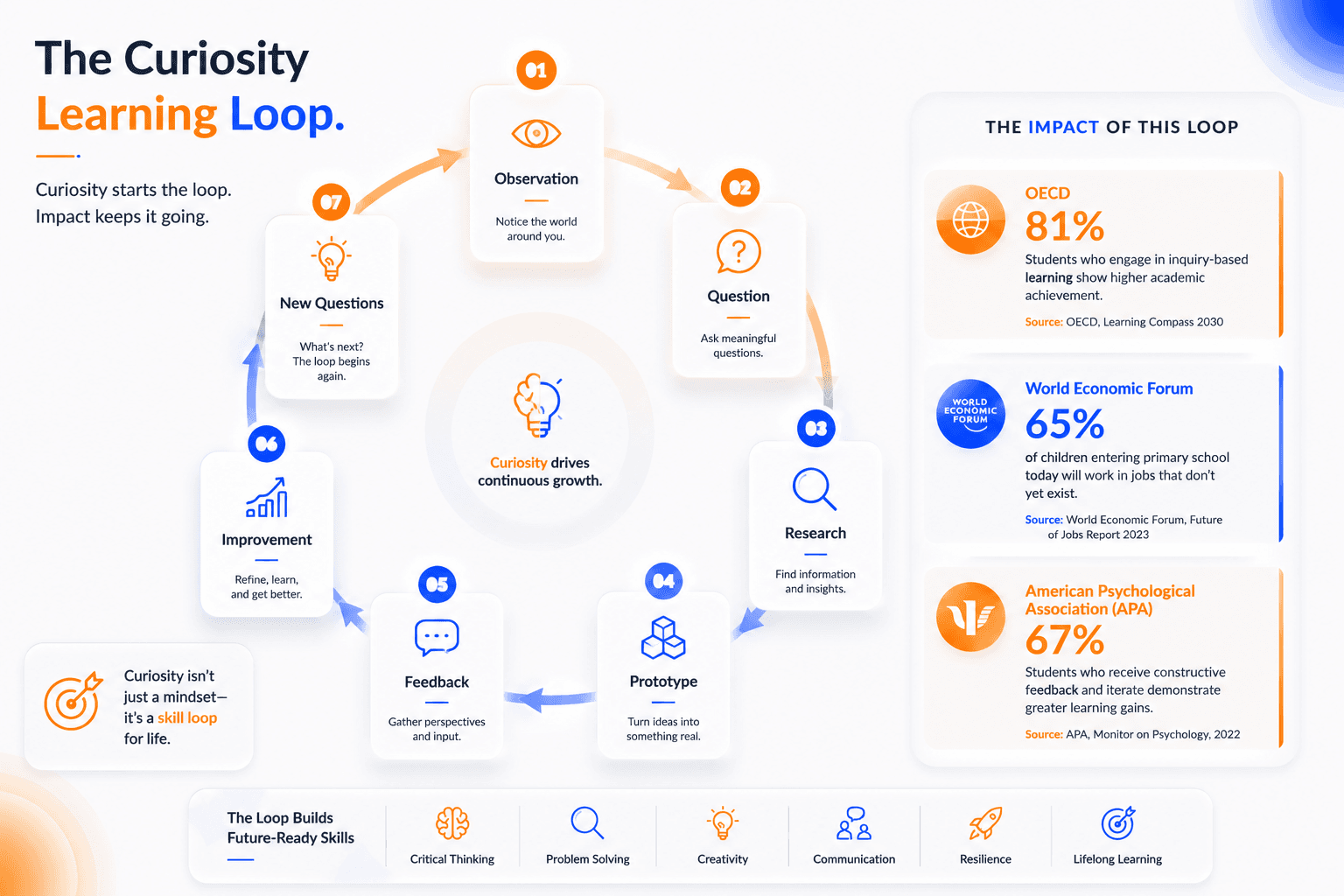
Intellectual curiosity is best developed before academic schedules become busy. Research consistently shows that students who independently explore ideas retain knowledge longer, demonstrate stronger problem-solving skills, and adapt more effectively to new challenges. Summer creates uninterrupted time for this deeper learning process.
Curiosity functions much like the feedback loop inside a machine learning system. Every question generates new information, every experiment provides additional data, and every iteration improves understanding. Students who repeat this cycle naturally become better thinkers.
Recent educational research supports this relationship.
- The OECD's Future of Education and Skills framework identifies curiosity as one of the core competencies needed for uncertain future careers.
- The World Economic Forum Future of Jobs Report 2025 ranks analytical thinking, curiosity, resilience, and lifelong learning among the most valuable workplace capabilities.
- Research published by the American Psychological Association continues to demonstrate that curiosity significantly improves long-term memory formation and engagement.
For students entering eighth grade, this matters because academic competition increasingly rewards originality rather than memorization. A student who investigates why local traffic congestion exists, analyzes environmental data, or builds an AI model to solve a community problem demonstrates learning that extends well beyond classroom expectations.
Parents often ask whether middle school is too early to begin exploring artificial intelligence. In reality, curiosity develops through age-appropriate exposure. Students do not need advanced mathematics to begin understanding how technology solves practical problems.
Instead of focusing on programming syntax, students benefit more from learning how to observe, question, test ideas, and iterate solutions.
If your child is looking for practical starting points, these beginner-friendly 5 AI Projects an 8th Grader Can Start Building Today provide excellent examples of curiosity translated into action.
The next question naturally becomes how parents can encourage this process consistently at home.
Practical Ways Parents Can Spark Curiosity at Home

Parents encourage intellectual curiosity most effectively by creating opportunities for exploration rather than providing immediate answers. Small, consistent experiences often have greater long-term impact than expensive educational resources or tightly structured schedules.
Many parents mistakenly believe curiosity requires exceptional talent or specialized instruction. In practice, it grows through repeated exposure to interesting problems.
Simple routines can create powerful habits:
- Ask open-ended questions during everyday activities.
- Encourage students to explain how technology around them works.
- Replace passive screen time with small building projects.
- Celebrate thoughtful questions instead of only correct answers.
- Encourage students to finish one meaningful project before starting another.
Project-based learning is especially effective because it combines multiple cognitive skills simultaneously. Students research, plan, build, test, revise, and communicate their work. Each phase reinforces deeper understanding.
Artificial intelligence projects are particularly valuable because they naturally combine computer science, mathematics, ethics, communication, and creativity.
Instead of asking, "Can my child learn AI?"
A better question is:
"What real problem could my child solve using AI?"
This shift transforms learning from content consumption into problem solving.
Parents planning the remaining weeks before school may also find useful guidance in What Should an 8th Grader Do Over the Summer, which outlines practical ways to build meaningful experiences before classes begin.
Structured mentorship also plays an important role. Students often progress significantly faster when experienced mentors help them refine ideas, overcome obstacles, and connect projects to larger concepts without removing the challenge of independent thinking.
The impact of this approach becomes much clearer when examining what one young student recently built.
Case Study: A Student-Built Community Solving a Real-World Problem
The strongest evidence of intellectual curiosity is solving an authentic problem that affects real people. One student identified a challenge within her own community and transformed that observation into a practical technology solution.
Figure skating is often described as an individual sport.
Athletes train independently, compete individually, and frequently struggle to connect with others who understand the demands of the sport.
Grace Young recognized this problem because she experienced it herself.
Rather than accepting isolation as inevitable, she began asking deeper questions.
Why isn't there a digital community built specifically for figure skaters?
What would athletes actually need?
How could technology strengthen human connection without compromising elite training?
Those questions eventually became a comprehensive community application featuring:
- Practice partner matching
- Secure chat and video communication
- Progress sharing
- Shared practice calendars
- Marketplace for equipment and coaching
- Community features inspired by modern social platforms while addressing the unique needs of figure skaters
The project demonstrates several characteristics universities increasingly value:
- User-centered problem identification
- Research-driven design
- Product thinking
- Technical implementation
- Social impact
Most importantly, the project did not begin with artificial intelligence.
It began with curiosity.
The technology became the tool rather than the objective.
This reflects the structured learning model increasingly adopted within advanced AI education: identify meaningful problems first, then develop technical solutions through iterative mentorship and project development.
Students who build projects like this also develop compelling portfolios for future internships, research opportunities, and university applications. Families interested in long-term planning may also benefit from reading The Ultimate Guide to High School Internships: Top 10 Internship Programs for 2026 to understand how authentic projects strengthen future applications.
Having seen how curiosity develops into meaningful work, it is helpful to address several common questions parents frequently ask.
FAQs
Conclusion
Report cards remain important, but they no longer tell the complete story of a student's abilities.
The students who increasingly stand out are those who demonstrate intellectual curiosity through meaningful exploration, thoughtful questions, and authentic projects that solve real problems.
That journey rarely happens through independent study alone. It benefits from structured projects, experienced mentors, continuous feedback, and opportunities to apply knowledge beyond the classroom.
At BetterMind Labs, students do exactly that. They work alongside expert mentors, build real AI projects inspired by genuine community challenges, and develop the habits of thinking that extend far beyond a single school year.
If your child is ready to transform curiosity into meaningful experience, explore the programs available at bettermindlabs.org and discover how project-based AI learning can become the foundation for future academic and professional success.