
Introduction
Science Fair Project Ideas have become easier to find than ever. So why are thousands of students still submitting projects that judges forget within minutes?
The answer is simple. Most students choose experiments that demonstrate concepts instead of solving real problems. Science fairs in 2026 increasingly reward originality, technical depth, and measurable impact. Artificial intelligence gives middle and high school students an opportunity to build projects that address genuine challenges in healthcare, finance, cybersecurity, education, business, and even space exploration. A thoughtfully designed AI project demonstrates curiosity, analytical thinking, and engineering skills that traditional experiments rarely showcase.
Table of Contents
- Why AI Science Fair Projects Stand Out in 2026
- 5 Science Fair Project Ideas Using AI for Students
- How to Choose an AI Project That's Original and Competition Worthy
- How One Student Built an AI Teaching Assistant for Peer Tutors
- What Judges Look for in Award Winning AI Science Fair Projects
- Frequently Asked Questions
- Conclusion
Why AI Science Fair Projects Stand Out in 2026
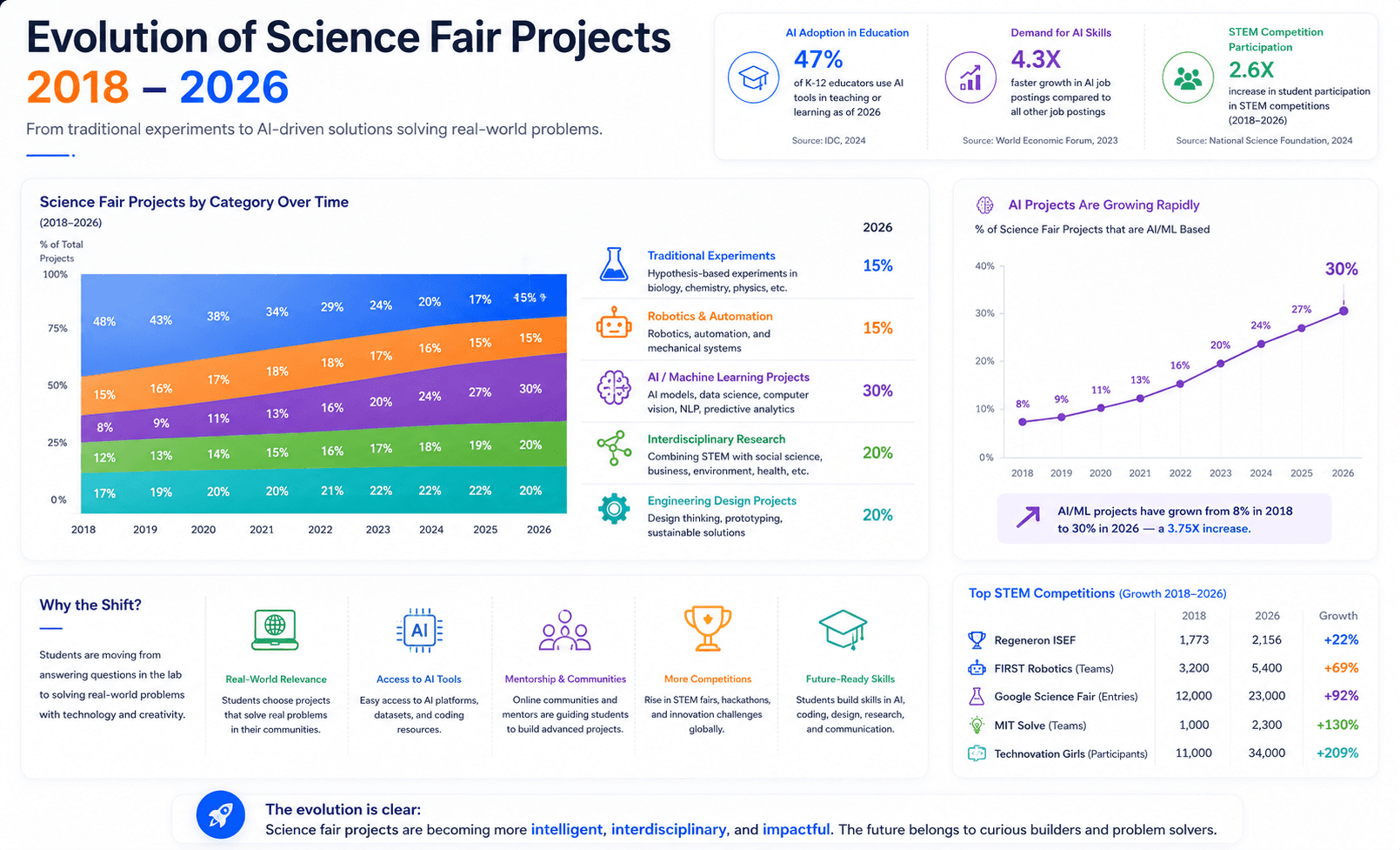
AI science fair projects stand out because they combine scientific investigation with real-world problem solving. Judges increasingly reward projects that collect data, build predictive models, evaluate performance, and demonstrate measurable impact instead of simply explaining existing scientific concepts.
Artificial intelligence is becoming part of nearly every industry. According to the World Economic Forum's Future of Jobs Report 2025, AI literacy and analytical thinking rank among the fastest-growing skills employers expect over the coming decade.
Universities have also expanded AI research opportunities for undergraduate students, making early exposure increasingly valuable.
An effective AI science fair project demonstrates several advanced competencies:
- Collecting and cleaning datasets
- Training or evaluating machine learning models
- Testing hypotheses with measurable results
- Explaining limitations and future improvements
- Considering ethical AI and responsible data use
Students who complete these steps naturally develop scientific reasoning rather than simply presenting information.
Instead of memorizing algorithms, successful students learn through structured project-based experiences supported by technical mentors who help refine research questions, evaluate models, and communicate findings clearly.
The next question becomes selecting an idea that is ambitious enough to impress judges while remaining achievable for younger students.
5 Science Fair Project Ideas Using AI for Students
The strongest AI science fair projects solve meaningful problems with accessible technology. Students should prioritize clear objectives, measurable outcomes, and practical usefulness over technical complexity.
1. Budget Buddy AI
Student: Neel Parimi
Domain: AI + Finance
Budget Buddy AI helps users categorize spending habits, identify unnecessary expenses, and recommend practical saving strategies using machine learning. Students learn data analysis, classification, and recommendation systems while addressing financial literacy.
2. Verifeye
Student: Sushanth Punuru
Domain: AI + Cybersecurity
Verifeye analyzes suspicious emails, messages, and URLs to identify phishing attempts using Google Gemini AI. Users complete a guided survey before receiving risk assessments and recommended actions.
This project introduces:
- Natural Language Processing
- Cybersecurity fundamentals
- Human-centered AI design
3. Injury Prevention and Rehabilitation
Student: Ozair Mohiuddin
Domain: AI + Healthcare
This AI assistant evaluates athlete training loads, injury history, and health indicators to estimate injury risk while recommending preventative strategies.
Students explore:
- Predictive analytics
- Healthcare datasets
- Risk classification
- Ethical AI in medicine
4. Mars Autonomous Landing AI
Student: Amaar Kothari
Domain: AI + Space Exploration
Using satellite imagery, this project divides Martian terrain into patches and predicts landing hazards before identifying the safest landing zone.
The project introduces students to:
- Computer Vision
- Image segmentation
- Space engineering
- Autonomous decision making
5. Employee Retention AI
Student: Aman Sreejesh
Domain: AI + Business
Employee Retention AI predicts workforce attrition by analyzing workplace factors and recommending strategies to improve retention.
Students investigate:
- Classification models
- Business analytics
- Explainable AI
- Human resources applications
Readers looking for additional inspiration can also explore Top 10 AI Science Fair Project Ideas for High School Students, 15 Passion Project Ideas Combining AI and Robotics for Top Colleges, and AI + Robotics Project Ideas to Win the Science Fair in 2026 on BetterMind Labs.
Choosing an interesting topic is only half the challenge. The execution often determines whether a project earns recognition.
How to Choose an AI Project That's Original and Competition Worthy
An award-worthy AI project starts with an authentic problem rather than an impressive algorithm. Strong projects clearly define the challenge, collect relevant data, evaluate results objectively, and explain practical significance.
Many students begin by asking, "What AI model should I build?"
A better question is:
"What real problem needs solving?"
Effective project selection usually follows this framework:
- Identify a genuine everyday problem.
- Find or collect relevant data.
- Select an appropriate AI approach.
- Measure performance objectively.
- Present limitations honestly.
Mentorship becomes particularly valuable during these stages. Experienced instructors help students avoid overly ambitious ideas while encouraging meaningful experimentation and scientific rigor.
Students interested in interdisciplinary work may also enjoy exploring AI and robotics combinations that integrate hardware with intelligent software.
The next example illustrates how this structured process translates into a successful student project.
How One Student Built an AI Teaching Assistant for Peer Tutors
Successful student projects rarely begin with advanced coding. They begin with observing a practical challenge, validating assumptions, and iteratively improving solutions with expert feedback throughout development.
One BetterMind Labs student noticed that peer tutors repeatedly answered identical questions before exams.
Instead of creating another chatbot, the student interviewed tutors, identified common misconceptions, collected anonymized tutoring conversations, and built an AI assistant capable of generating personalized explanations for recurring questions.
Throughout development, mentors guided:
- Dataset preparation
- Prompt engineering
- Evaluation metrics
- User testing
- Presentation strategy
The final project demonstrated measurable reductions in tutor workload while improving consistency of explanations.
This structured approach mirrors real engineering workflows rather than isolated classroom assignments.
The same principles also influence how judges evaluate projects during competition.
What Judges Look for in Award Winning AI Science Fair Projects
Judges consistently reward projects with clear research questions, reliable methodology, measurable evidence, thoughtful analysis, and practical applications rather than technical complexity alone.
Winning projects typically include:
- A clearly defined problem
- Originality
- Reliable datasets
- Appropriate AI methodology
- Honest discussion of limitations
- Well-designed presentation
Students who explain why a model succeeds or fails often score higher than students who simply report accuracy percentages.
Understanding judging expectations naturally raises practical questions from students and parents.
Frequently Asked Questions
Conclusion
Science fairs increasingly reward students who apply scientific thinking to meaningful real-world challenges instead of repeating familiar classroom experiments. Artificial intelligence provides an accessible pathway for curious students to investigate healthcare, finance, education, cybersecurity, business, and space exploration through measurable, research-driven projects.
At BetterMind Labs, students work through a structured project-based AI and machine learning program that combines expert mentorship, collaborative learning, and real-world project development. Rather than following step-by-step tutorials, students learn how to ask better questions, build reliable AI systems, evaluate results scientifically, and confidently present their work.
If you're looking for a science fair project that develops lasting technical skills while preparing students for future academic opportunities, explore the AI and Machine Learning programs available at BetterMindLabs.org.