

Introduction
If internships are widely available, why do many high-achieving students still fail to differentiate themselves in competitive college admissions?
The issue is not access. It is output. Admissions committees now evaluate students using a logic similar to model validation. Inputs such as GPA and coursework establish baseline capability, but outputs such as real-world work, documented impact, and applied problem-solving carry far greater weight. This is where summer internships can either become transformative or remain superficial.
For high school students in San Antonio , the landscape is rich with opportunities across research, policy, and technology. Yet only a subset of these Top 10 summer internships consistently produce measurable outcomes. The difference lies in whether students are actively building and contributing or passively observing. Understanding that distinction is critical before choosing any program.
Table of Contents
- 10 Summer Internships for High Schoolers in San Antonio
- Beyond the Resume: Navigating High-Stakes Placements
- Case Study: AI-Based Attrition Prediction System
- Frequently Asked Questions
10 Summer Internships for High Schoolers in San Antonio
San Antonio offers a wide range of summer internships, but their impact varies significantly depending on structure, mentorship, and expected outputs.
Below are ten programs that stand out based on outcome quality, project depth, and real-world exposure.
Top 10 Summer Internships
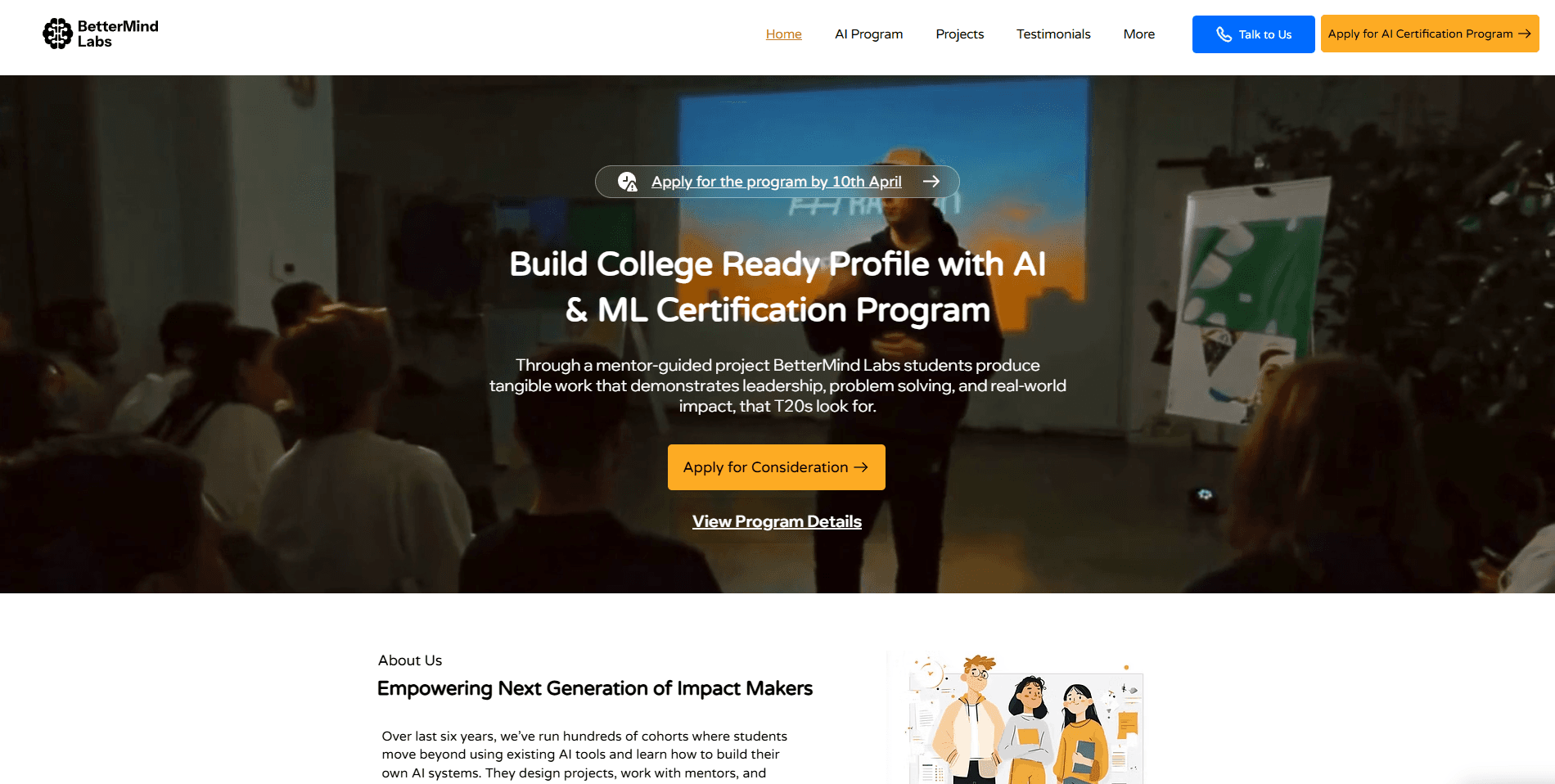
- BetterMind Labs AI and ML Summer Internship Program A structured 4-week remote program where students build deployable AI models in domains such as healthcare and mental health analytics. Outputs include reproducible code, certifications, and mentor-backed recommendations.
- UT Austin High School Research Academy students conduct lab-based research in biology, physics, or neuroscience, culminating in presentations and potential publications.
- UT Austin McCombs Six Day Experiences Short-term business and leadership programs with case-based simulations and networking opportunities.
- Texas Sea Grant Community Engaged Internship: Paid internships focused on environmental data collection and public outreach across coastal regions.
- Rice University's HEDGE Summer Fund supports students working in social impact roles with reflective portfolios and professional exposure.
- University of Houston Social Economy Academy Students design social enterprises addressing real economic challenges through structured mentorship.
- UT Austin Strauss Institute Civic Internships Focuses on civic engagement, policy, and education initiatives with hands-on project involvement.
- Texas A&M Sustainability Internship students work on environmental projects involving data analysis and policy implementation.
- UT Austin RGK Nonprofit Internship Funding Provides funding for nonprofit internships with mentorship and structured reflection.
- Baylor University Social Work Practicum: Field-based placements focused on counseling, advocacy, and community support systems.
What differentiates high-impact internships
- Clear deliverables such as research reports, models, or prototypes
- Continuous mentorship rather than occasional supervision
- Defined problem statements with measurable outcomes
According to a 2024 National Association of Colleges and Employers report, students with project-based internship experience are significantly more likely to demonstrate job-ready skills compared to those with observational roles. Similarly, McKinsey reports that applied experience is one of the strongest predictors of future performance in technical fields.
- AI Summer Programs in Texas: 2026 High School Guide
- Why High School Internships Matter for College Admissions in 2025
This raises an important question. If internships vary in structure, how should students evaluate which ones truly matter?
Beyond the Resume: Navigating High-Stakes Placements

Choosing among summer internships requires more than scanning program descriptions. It requires understanding how learning translates into outcomes.
Think of it like system design. A well-designed system produces consistent outputs. A poorly designed one produces noise.
Key Factors That Determine Internship Value
- Problem ownership Did the student actively contribute to solving a problem?
- Mentorship structure Was feedback continuous and specific?
- Output clarity What exactly did the student build or produce?
- Iteration cycles Did the student refine their work based on feedback?
A 2023 Stanford HAI study found that students engaged in mentored, project-based learning produced more complete and technically accurate outputs compared to those in passive environments. Additionally, CollegeVine notes that over 60 percent of successful STEM applicants present project-based work in their profiles.
Structured Learning Model That Works
The most effective internships follow a layered approach:
- Phase 1: Concept grounding Students learn foundational principles relevant to their domain
- Phase 2: Guided execution Mentors support students in building a defined project
- Phase 3 Independent output Students produce measurable results such as models or reports
This structure mirrors how engineering systems evolve. Initial prototypes are refined through iterative testing until performance stabilizes.
Common pitfalls in low-impact internships
- Undefined roles leading to passive observation
- Lack of measurable outputs
- Minimal mentorship or feedback
Top Summer Internships for high school students Interested in Healthcare Top 10 High-Impact Programs
This leads to a practical question. What does a strong internship output actually look like in a technical domain like AI?
Case Study: AI-Based Attrition Prediction System
Consider a student working on an AI-based system to predict employee attrition.
At first glance, the task appears abstract. Predict whether an employee might leave. But the complexity emerges in data selection, model design, and evaluation.
Project Breakdown
- Data preprocessing using structured datasets
- Feature selection such as work hours and engagement metrics
- Model training using classification algorithms
- Evaluation using accuracy and precision metrics
Iterative Development
- The initial model shows low predictive accuracy
- Feature engineering improves performance
- Model tuning reduces error rates
Final Output
- A functional predictive model
- Documented methodology and results
- Clear explanation of limitations
This reflects how real AI systems are developed. Each iteration improves performance, similar to how optimization algorithms reduce loss.
Research from Harvard Undergraduate Research shows that students presenting structured project work receive stronger academic endorsements compared to those presenting only participation.
Why this case matters
- It demonstrates applied problem-solving.
- It produces measurable outcomes
- It provides verifiable evidence
Top AI ML Project Ideas for Beginners: 7 Hands-On AI Projects That Actually Build Real Skills
Build an Award-Winning AI Science Fair Project for High School Students
This brings us to practical concerns students and parents often raise before committing to an internship.
Frequently Asked Questions
Conclusion Securing Your Competitive Edge

Admissions decisions increasingly rely on evidence rather than intention. Academic performance establishes capability, but it does not differentiate.
A well-structured internship functions like a high-value feature in a predictive model. It provides insight into how a student applies knowledge, solves problems, and iterates under constraints.
The most effective summer internships are those that prioritize building over observing. They guide students through structured learning, supported by mentorship and measurable outputs.
This is where structured AI and project-based programs become essential. They convert effort into evidence, helping students build portfolios that are both credible and compelling.
If you are evaluating your next step, focus on pathways that emphasize real work and clear outcomes.
Explore the BetterMind Labs blog and programs to understand how structured internships can translate into meaningful academic and professional advantage.

Leads the AI ML Program at BetterMind Labs. Writes about choosing a first project, program fit, and what parents should ask before enrolling.